



Corten Fence — what it is, why choose it and what you need to know before buying
If you've ever seen a fence in a warm, brown colour that seems to live and breathe — you were most likely looking at corten. But what exactly is this material, why is it increasingly popular and is it right for your home? In this article, we explain everything you need to know.
4/8/20262 min read
| What is corten steel?
Corten — officially called weathering steel — is a special alloy that develops a protective patina layer on its surface when exposed to the elements. This layer of rust is not a defect. It is the essence of the material. It acts as a natural shield that prevents further corrosion into the depth, while the material acquires over time that characteristic warm, brown-orange colour we all know.
It was originally developed for use in industrial architecture and bridge construction. Today it has become one of the most sought-after materials in contemporary home, garden and public space design.
| Why choose a corten fence?
The reasons are both practical and aesthetic. From a practical standpoint, corten is extremely durable. Once the protective patina has established itself — which takes a few months — the material requires no maintenance whatsoever. No painting, no varnishing, no annual repairs. It simply stands there and grows more beautiful.
From an aesthetic standpoint, every piece of corten is unique. The patina develops differently depending on the micro-location, exposure to rain and sun. Your fence will look different from your neighbour's in five years, even though it was made from the same material. A rarity in a world where everything is mass-produced.
Corten combines excellently with contemporary architecture, concrete, wood and glass. It adds warmth to cold facades and character to minimalist homes.
| What shapes are possible?
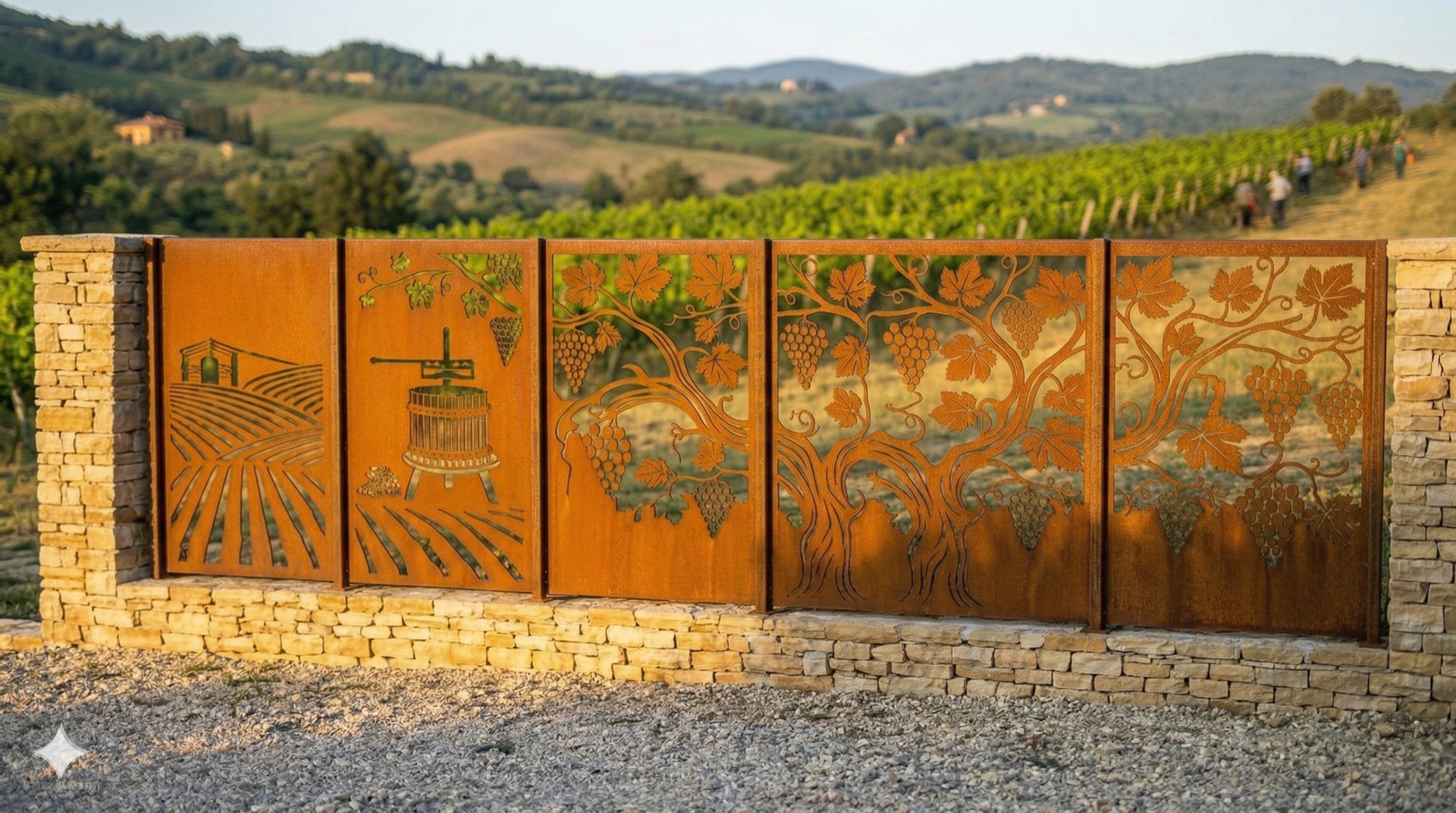
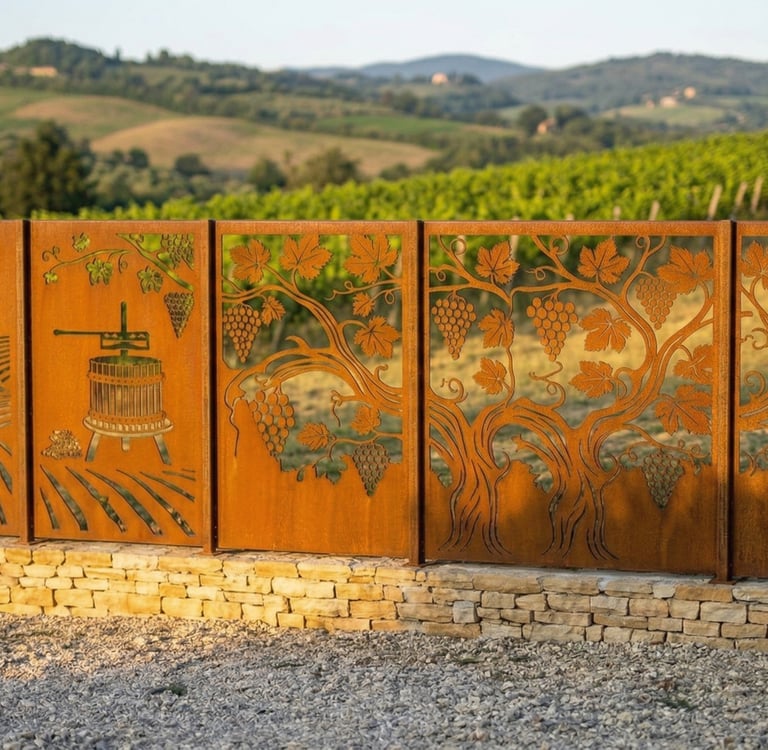
A corten fence doesn't just mean flat panels arranged in a row. Modern laser cutting technologies enable extremely precise and complex patterns — from geometric shapes to organic motifs of trees, leaves or abstract compositions. The possibilities are practically unlimited.
The fence can be solid for complete privacy, perforated for a play of light and shadows, or a combination of both. It can serve as a classic roadside fence, a decorative partition between garden zones, or an artistic element that defines the space.
| What you need to know before ordering?
Corten actively develops its patina in the first months after installation. During this period, rusty water can run off and stain surrounding light surfaces — concrete, stone, light paving. This is a normal process, but it needs to be considered during planning. An experienced manufacturer will warn you about this and suggest appropriate solutions — for example, suitable distance from light surfaces or a protective coating on the lower section.
The thickness of the sheet metal is also important. Sheet metal that is too thin can warp, while too thick makes laser cutting of details difficult. The optimal thickness for fences is generally between 2 and 4 mm, depending on the size and shape.
| How much does a corten fence cost?
The price depends on dimensions, pattern complexity and installation method. A corten fence is generally more expensive than a classic metal or aluminium fence, but cheaper than a quality wooden fence that requires regular maintenance. When you add up the maintenance costs over the years, corten becomes a financially very sensible investment.
The best way to get a realistic cost estimate is to send us the dimensions and description of your desired design. At KovinArt, we prepare a quote within 48 hours, and consultation is free.
Terms and conditions
info@kovinart.com
+38640863350
© 2026. All rights reserved by KovinART, Klemen Vidmar s.p.